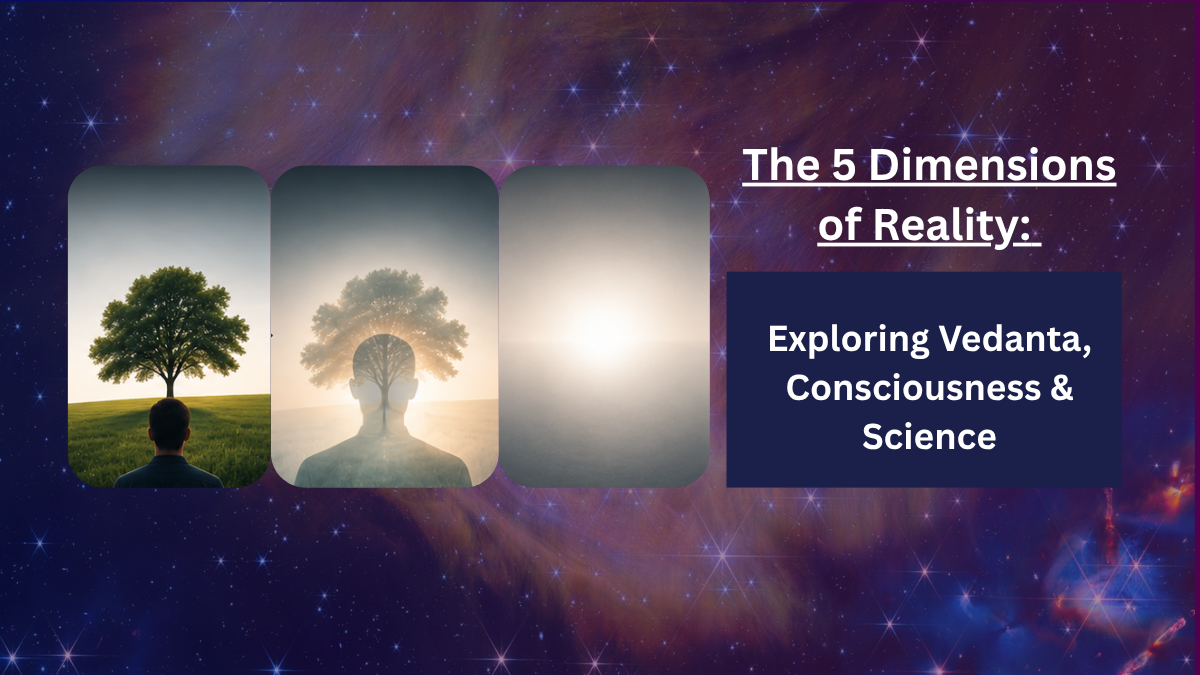

Science has repeatedly shown us that reality isn’t always that simple. Gravity and speed can influence how faster or slower time flows. Light can behave like both a wave and a particle. The mystery of how consciousness appears is still unsolved. There are many such fascinating layers of reality that we normally don’t seem to ponder upon. We don’t seem to realize it but the observer (you) and the observed (the sun, trees, mountains, this article, etc) are deeply interconnected. The 5 different dimensions of reality inspired by the teachings of Advait and Vedanta helps us go from the reality of the physical world to something more profound.
In Physics, we’ve learnt that there are multiple dimensions of reality. For example,
- One Dimensional (1D) = line (only length)
- Two Dimensional (2D) = plane (length + width)
- Three Dimensional (3D) = space (length + width + height) e.g., our physical world
- Four Dimensional (4D) = adds time as a dimension (space-time)
- Five Dimensional (5D) and beyond = theoretical higher dimensions (in string theory, etc.)
However, in this article, we are going to explore what are the different dimensions of realities as per some concepts of the Advait and Vedanta and try to see each of them from a science point of view as well.
So, the 5 dimensions of reality are said to be the Brahma (physical), Ardha (mental reality), Nagna (conscious), Purna (unified reality), and Atal Satya (unspoken reality).
.
[ 1 ] Brahma Satya: The Physical Reality We See Around Us
The first dimension of reality is Brahma. The physical world around us is said to be represented by this stage of reality. It’s everything we can see, hear, smell or touch. However, this dimension of reality is temporary and can change. For example, an object seems to appear bigger or smaller based on how farther or closer the observer is.
For example, the sky often appears blue but in deeper reality, the sky is transparent and the blue colour we see is actually an illusion of how our eyes and brain processes light waves.
Similarly, stars do not actually twinkle. The flickering is an illusion that gets created by the Earth’s atmosphere.
Brahma Satya Examples: Perception vs Reality
- A dog and a human looking at the same tree can see entirely different colours. Humans can see red & green whereas dogs have fewer colour receptors and hence might see the same tree in entirely different colours
- An airplane in the sky appears tiny but massive when we are close to it
- The Sun seems to rise and set but in reality it’s the Earth rotating on its own axis
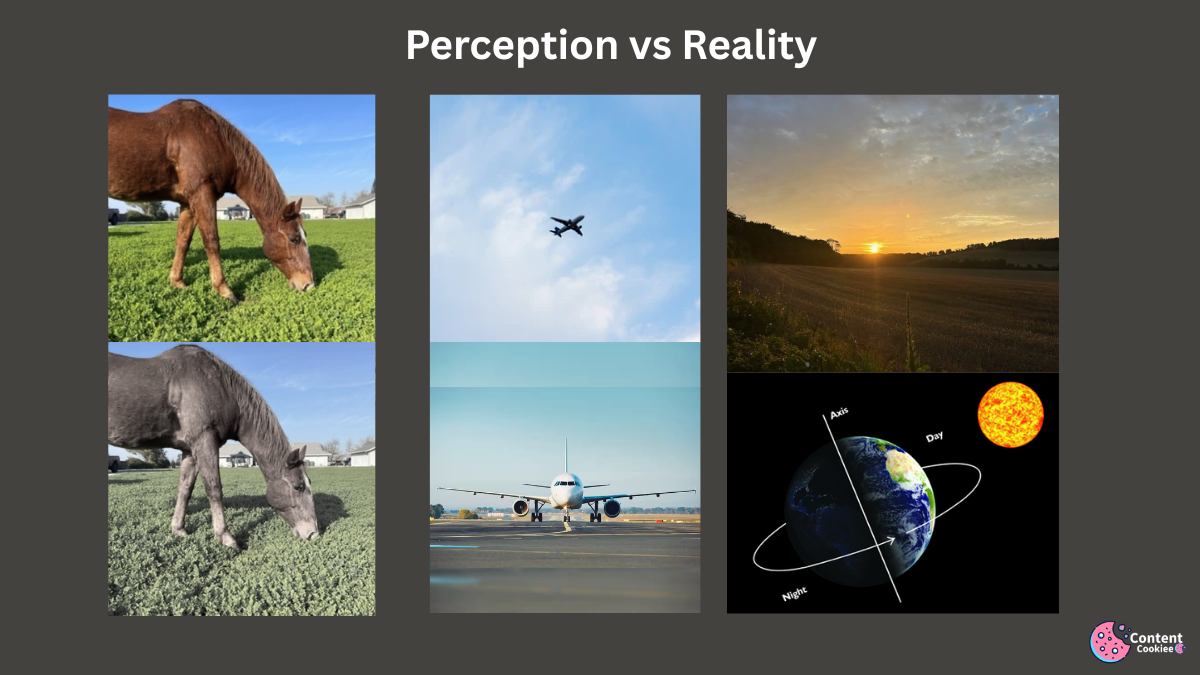
In summary, Brahma Satya is the dimension of physical illusion. What we experience feels real but it is likely to be shaped by light, angle, or perception.
.
[ 2 ] Ardha Satya: The Mental Reality We Cannot Always See
The second dimension is Ardha Satya. It is said to govern our dreams, emotions, subconscious patterns, karma, intuition, and realities that are usually unseen but do influence life. Ardha Satya is also knowing that as humans, our experience of life is not the final and the only truth. It’s knowing that life can be experienced in different forms and shapes.
An interesting example could be the Spiral, Fractal, Wave & other patterns found in nature & universe.
For example, it’s said that nature uses a Spiral pattern for expansion & flow (what we see in sea shells, storms, galaxies).
Whereas, trees tend to use a Fractals pattern for growth and to maximize surface area. A tree branch looks unique individually but when you zoom out, every branch seems to follow a Y-shape. This is what a Fractal pattern is. Other examples could be snowflakes, human lungs, coastlines, etc.
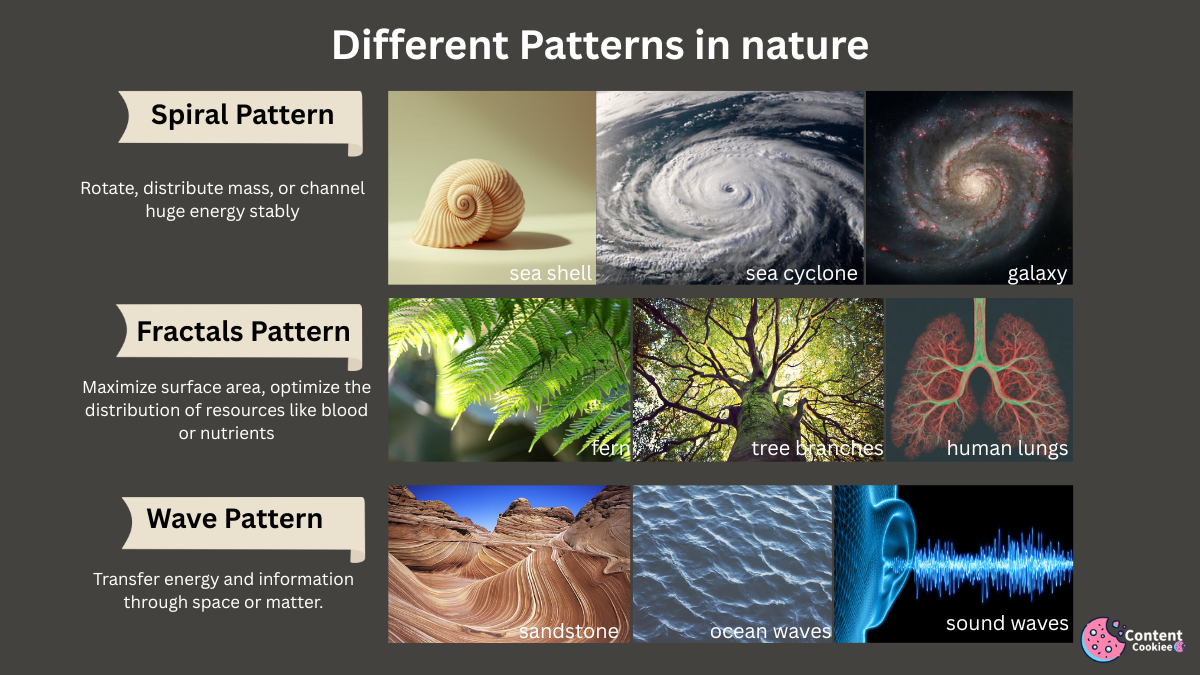
So both, a storm and a tree could be expanding and yet their realities of how that expansion happens or looks can differ a lot.
On the same lines, humans can have sleep rhythms, hormonal rhythms while plants can follow blooming cycles. There are also patterns of synchronisation we see in nature… the way fireflies blink together while birds flock in patterns and even human heart cells beat in unison.
This dimension makes us realize that perhaps, reality is not limited to just physicality. A truth can exist even when we do not “see” it OR even when it isn’t similar to our sense of reality.
.
Ardha Satya Examples: The non-physical or invisible principles in nature
- You sense someone staring at you before you actually see them (explained in this study by Nuffield Department of Clinical Neurosciences)
- A nightmare can make your heart race even though nothing physical is happening.
- A study on Plant Communication shows trees release chemical signals VOC to warn nearby trees of insects attack.
- Some animals like birds, dogs, and even insects can sense earthquakes or predators through subtle vibrations even before humans
- Sometimes we get a “bad feeling” about a person or place before we logically understand why. An Early Amygdala Reaction study shows this sometimes happens because the amygdala reacts to threat cues 200 to 300 ms before we can put it into words.
.
In summary, Ardha Satya is the truth that reminds us there is more to reality than what we can physically see or immediately understand. Our thoughts, intuition, emotions, etc., may not always be visible, yet they can still shape the way we experience life.
.
[ 3 ] Nagna Satya: What If Consciousness Is the Deeper Reality?
The 3rd dimension of reality is Nagna Satya. It’s said to be the truth stripped of all illusions, projections and limitations. This truth is said to be of the Hindu God Shiva… pure awareness or consciousness. It’s realising that all our experiences are arising and ending in our consciousness.
For example, when we wake up in the morning, we see the Sun, it exists. But what if we do not see the Sun? Then… does it still exist? What if it exists only because we, consciousness, is seeing it? If one fine day, something bad happens and we are no more. Then would the Sun still exist?
Empirically, we might think yes, the Sun would still exist for others.
But if we think from our own, individual reality. The moment we are no longer conscious, there is no longer a Sun that we see, no warmth that we feel and no sky that we can look at. So technically, once our consciousness is no longer present, we cannot certainly say whether even the Sun exists or not.
It’s worth thinking that without consciousness, in what way can the universe ever be known or experienced? Everything we have ever known about reality… the Sun, the Earth, other people, our own body, mind, thoughts and dreams seems to have appeared to us only through consciousness.
The physical and mental realities may change. However, something fundamental witnessing it all seems to remain the same, our consciousness.
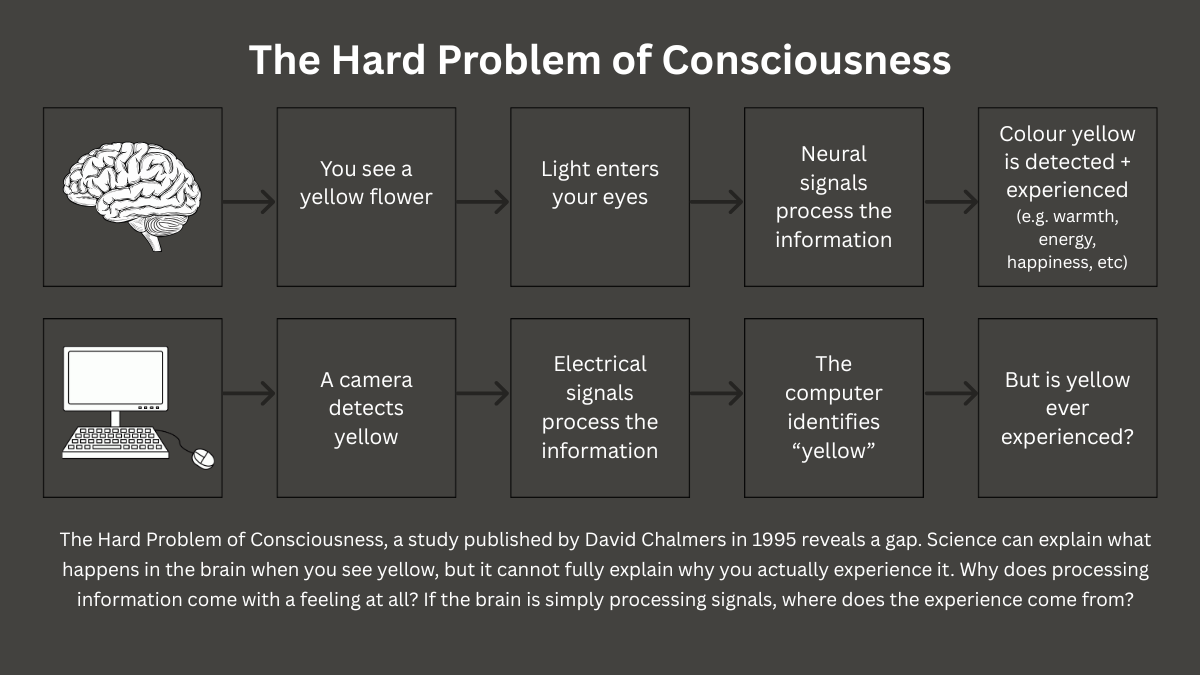
Nagna Satya Examples: Are We the Experience or the Awareness Behind It?
- Under anesthesia, doctors can numb our sensory senses. But when we wake up, we still have a sense of “I”. Similar to when we wake up from a dream and immediately think, “I was dreaming,” it shows that some part of us was probably aware of the dream all along even when our conscious mind wasn’t at that time.
- In meditation, we may notice sounds, sensations and thoughts coming and going, while simply remaining aware of each one.
- You can feel anxious about something and still affirm, “this is anxiety…it will pass.” That means there must be something within you that notices the anxiety and consciously chooses to separate itself from it.
- When we watch our breath for a few moments, we realise that breathing happens automatically. We do not need to consciously command every breath… we can simply become aware of it happening.
- We can stare directly at something yet fail to consciously notice it when our attention is focused elsewhere. Studies on inattentional blindness show that people can miss surprisingly obvious events simply because they are not consciously attending to them.
The gist of all of these examples is probably that we’re not just the experience, we’re more importantly the awareness of that experience itself.
.
In summary, Nagna Satya tells us that the things we do, feel, see or hear in our day to day lives are constantly changing. It also coincides with Shri Adi Shankaracharya’s idea of “Jagat Mithiya..” (the world is an illusion). This doesn’t necessarily have to mean that the physical world we live in is untrue or unnecessary. It simply means that most of what we experience is temporary and a more fundamental truth is our consciousness that is always present in the background.
.
[ 4 ] Purna Satya: What If Everything Is More Connected Than It Seems?
Purna Satya (Complete Truth), the 4th dimension of reality is where things begin to get a little more metaphysical. The lines between the observer and the observed reality begins to blur. This is said to be the stage of maya (illusion) or Shakti (Goddess Parvati) who is said to make the one (consciousness) appear as many (the universe).
In Nagna Satya, we still somewhat believe that “I am here” and “the Sun is there”, that our consciousness is here and the observed universe is somewhere outside of our consciousness. And, not that it’s untrue. But Purna Satya perhaps tells us that the observer and the observed reality are also deeply interconnected.
Quantum entanglement offers a fascinating way to think about interconnectedness. In Quantum Entanglement we learn that particles of the same origin stay “correlated” to each other no matter how far apart they may be.
This does not have to mean that the particles are literally “communicating” with each other across space. But it does tell us that two objects that seem separate can still be far deeply interconnected than what we may think.
Perhaps this is where the idea of Purna Satya becomes interesting. What appears to us as many separate things (me and you, observer and observed, here and there, etc.) may at a deeper level be far more interconnected.
In Purna Satya, instead of choosing one reality over the other, we begin to realize that all realities may exist simultaneously and could be true.
Studies like the Double Slit Experiment have shown us how measuring which path a particle takes changes the pattern we observe. For example, when we send a single photon toward two slits, something really fascinating happens…
- If we do not observe the photon, which slit it goes through, it behaves like a wave form and goes through both slits simultaneously which creates an interference pattern (i.e.multiple possibilities exist)
- But the moment a detector (an observer which is not necessarily conscious) is placed to measure which slit it passes through, it suddenly behaves like a particle and goes through only one slit (i.e. multiple possibilities collapses into one, single definite point)
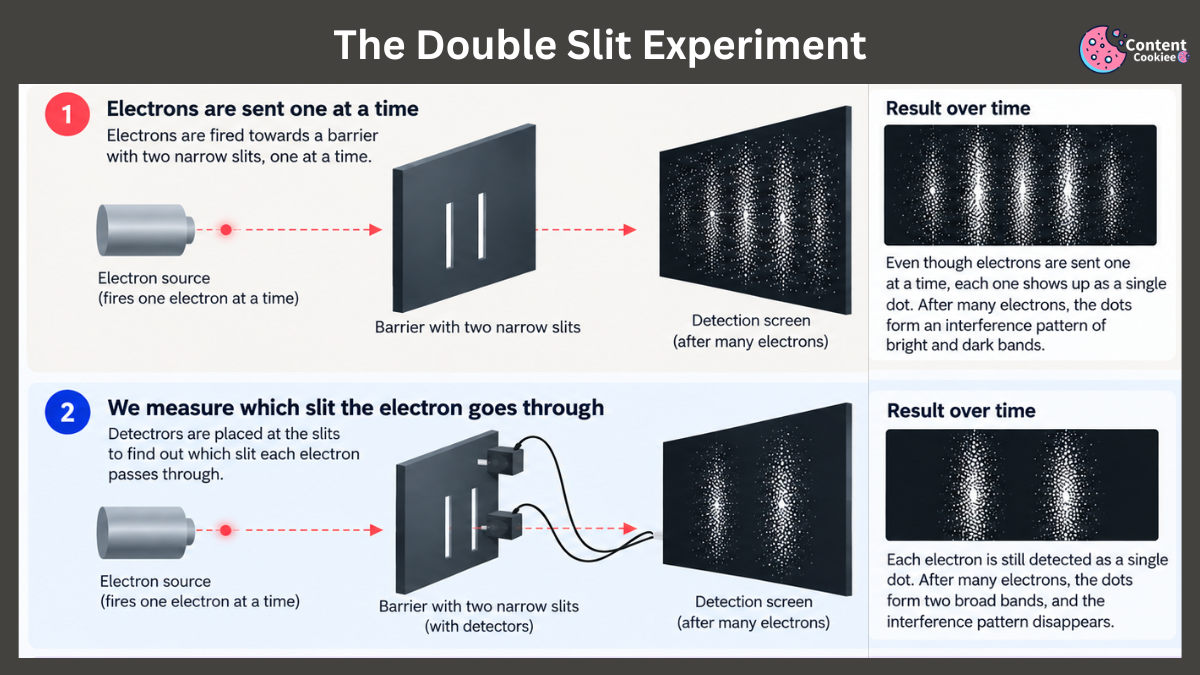
This experiment in itself tells us that when we measure something extremely small like a photon, the way we measure it can affect what we observe. At this tiny scale (also called quantum level), nature doesn’t always behave in the simple “either this or that” way.
There’s this fascinating Hindu Upanishad text that I could of think here:
“When there was nothing, no existence of time, space or the universe as we know it today, only pure, undivided consciousness (Parabrahma) existed. Then something happens. A “spanda”, which means a subtle vibration occurs.
This probably isn’t a physical vibration (since there’s no physical world yet), but more like the first “impulse” or “intention” arising within Shiva itself (pure consciousness), through Shakti (energy), for the One to become many.”
As the Upanishad saying goes “Ekoham Bahusyām” – “I am One, let Me become many” (Chandogya Upanishad 6.2.3).
It’s said that from this came the appearance of separation (me and you, here and there, us and the universe, etc.)
Purna Satya Examples: Are we really as separate from the universe?
- Studies from NASA and Sloan Digital Sky which surveyed over 200,000 stars and other researches have found that many of the elements in a human body, apart from hydrogen and most helium originated from the death of stars when they ran out of fuel and exploded as supernovas.
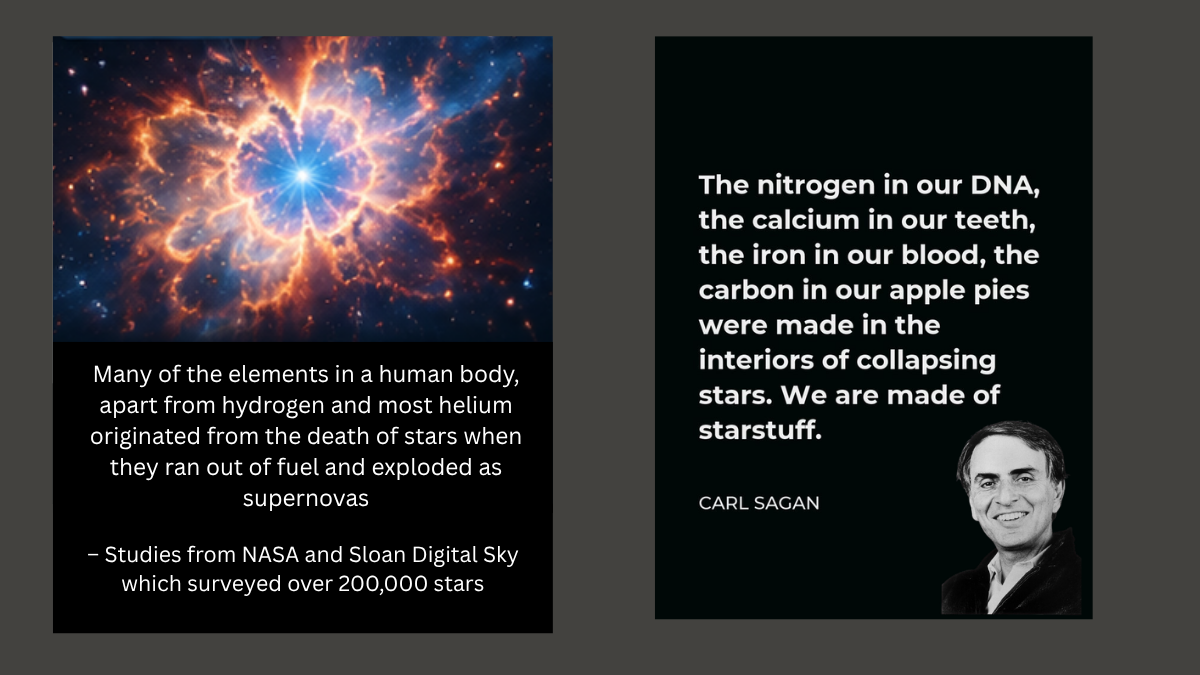
- There’s a scientific theory called the Big Bang Nucleosynthesis which says that some of the hydrogen atoms found in our body formed just minutes after the Big Bang, 13.8 billion years ago. It’s fascinating to think that something within us is so deeply connected to the beginning of the universe itself.
.
- Another fascinating example could be GPS satellites. It’s said that time moves at a slightly different speed for a GPS satellite than it does for us on Earth. Because the satellite is moving very fast, time moves faster for it. And also because GPS satellites are usually farther from Earth (a heavy object with a lot of gravity), they experience less gravity and time moves faster in a different way too. GPS systems have to account for both of these effects at the same time to give us accurate locations.
.
- The same fundamental laws of physics that govern us also affect the stars, planets and others in space. For example, the gravity that keeps our feet on ground on Earth also holds planets in their orbits. The General Relatitivity rules we apply to our GPS satellites also apply to black holes.
.
- Light shows both wave-like and particle-like properties depending on how it’s measured or observed. This tells us that everything in this universe may not always be as simple as either “this” or “that.” Sometimes two or more “realities” can exist at the same time.
.
Something also worth noting is that it’s only through our physical body, can we explore liberation, enlightenment, consciousness, science and everything else and we’re doing all of it within a materialistic reality/world. The physical materialistic realm we call Maya (illusion) is also the very medium through which we can observe or understand life and the universe. So we cannot simply negate our materialistic world/experience and assume that anything physical is somehow less real or less important.
In summary, Purna Satya asks us to look beyond “either”, “or”, thinking. Light can behave as both a wave and a particle. A person can be both a biological body and a conscious being. The material reality we live in could be both an illusion (Maya) and the very reality through which we experience and understand existence.
.
[ 5 ] Atal or Nishabdh Satya: The Reality We Cannot Fully Explain
Atal Satya (unshakable truth) or Nishabdh Satya (unsaid truth) is by far the hardest dimension to understand because the moment we try to explain it, we have already created two things – the one who is understanding and the one that is being understood. And that itself is duality which is something Atal Satya asks us to look beyond.
There is an interesting concept in Physics called Singularity that I think can draw parallel to Atal Satya. But let’s first understand what a singularity actually means.
As we know gravity affects everything in the universe including stars. Stars are mostly made up of huge clouds of hydrogen gas, pulled together by gravity. But when a massive star runs out of its fuel hydrogen to balance the gravity force, it begins using other heavier elements as fuel to survive.
Eventually the star ends up building an extremely hot and dense iron core (a few billion degrees of Celcius). However, the dense iron core cannot release the same energy the star needs to fight the force of gravity acting on it. Eventually, gravity wins and blasts the star’s outer layer in space and the remaining core keeps getting denser and denser due to gravity (because gravity keeps pulling things inward).
And we know that the heavier an object is, the higher the gravity it experiences. If the star was massive enough, it turns into a black hole and the gravitational pull becomes so strong near its dense core that it forms an invisible boundary called the Event Horizon, a point of no return. Anything that goes inside cannot come back to the universe, not even light (the fastest travelling energy in the universe).
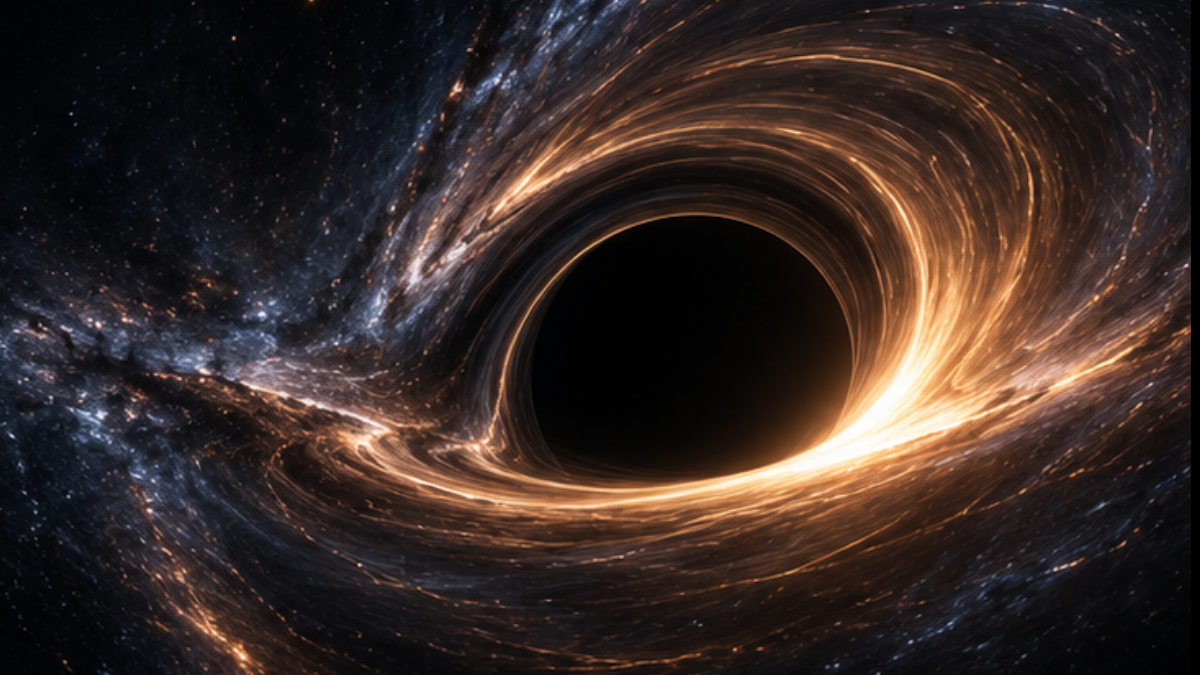
And what happens to the collapsing, dense core is even more mysterious. According to Einstein’s theory of General Relativity, the collapsing dense core eventually reaches “singularity”, where gravity becomes so extreme that our current laws of physics result in values like zero and infinity. We can no longer properly understand what is happening there to space, time and matter.
And this is where I feel there is an interesting connection with Atal Satya. A singularity is not something we can simply look at and understand. In fact, we don’t even know whether the singularity 100% exists or not.
We can imagine that Nishabdha Satya is something that is beyond duality (no separation) but we can’t seem to imagine the FELT experience of that “no separation”, not being an observer and neither being the observed.
Atal or Nishabdh Satya: What Happens When There Is No Observer?
For example, we can imagine what it’s like to say “I am observing the tree” or “I am aware of the awareness within me that is observing the tree”. But, there are still two things here – I and the awareness. There’s still a sense of separation.
But can we try to imagine a reality where there is no “I” and no “tree”? Even if we close our eyes and imagine that “nothing” exists – neither “I” nor the tree. We still end up creating a separation because there’s still the one (observer) who is imagining “nothing” (the observed)
It’s like we understand “hot” because we know what “cold” feels like. We understand “big” because we have an inherent idea of what “small” is. The very existence of a “yes” is because “no” exists too. In the same way, the existence of “I” itself means that there’s something that is not “I”. If “I” exists, “you” exists too. If “observer” exists, the “observed” exists too. And it leaves us with this paradoxical question of, “can we try to observe the tree without being an observer itself?”
We can imagine an “I” observing something, but we cannot imagine what it feels like when there is no “I” and no “something else” to observe. The moment we try to observe that experience, we have already created an observer and something being observed. Perhaps that is the paradox of Atal Satya, the moment we try to understand it, we move away from it because understanding itself requires a separation between the one who understands and the thing being understood. We can never “observe” something without being an observer itself (without a separation).
As humans there’s no doubt we have made enormous progress in science, technology and history but we are also limited by the laws of physics and perhaps even things that are beyond our understanding or imagination. We may have studied the observable universe across millions of light years but we cannot be absolutely sure that it’s all that exists. Sometimes, perhaps, the most intellectually honest answer is simply, “I don’t know.”
“We must be clear that when it comes to atoms, language can be used only as in poetry.” – Niels Bohr
Author’s disclaimer: This article brings together ideas from science, philosophy and Vedanta to explore different ways of thinking about reality. Some of the scientific concepts discussed, such as quantum mechanics, consciousness and singularities, are active areas of research and are not fully understood. The connections drawn between these scientific ideas and the five dimensions of Satya are my own interpretation and should not be taken as scientific proof of any spiritual or philosophical claim.
Where established scientific findings are discussed, they are presented as such. Where I move into interpretation, philosophy or speculation, I have tried to make that distinction clear. The purpose of this article is not to prove one particular view of reality, but to explore questions, examine different perspectives and encourage curiosity.
.
Author’s Note: Some of the ideas and questions explored in this article were also inspired by Abhay Singh’s book, A Beautiful Place to Get Lost. The book made me look at spirituality, consciousness and reality from perspectives that stayed with me while writing this piece:))
Following is a snip from it: